Friday, February 3, 2017

H.S. YOUTH: Great Faith Sharing Projects

I forgot that I'd made these videos and found them today when I was looking at my YouTube channel (more math videos than anything so don't get too excited). Anyway, kids love creating videos and we need to have them express what they believe in different ways so they become uber comfortable with it; comfortable enough to be able to freely share it. My standard church education goal is to have everybody be able to answer two questions without hesitation.
  1. What do you believe? 
  2. Why do you believe it?
I also want them to be as biblically literate as possible and this is one more way for them to become more familiar with what it says and be able to share it in their own words. You can choose any topic or story, but it can't be completely direct from the Bible. They can and should add a few verses to support what they believe, but it needs to be in their own words.

WARNING! Be careful about your choice of music if you upload your videos to YouTube or elsewhere on the internet. There are copyright laws about using other people's music and YouTube is good at noticing those kinds of things. If you need some public domain photos use Pixabay or Wikimedia Commons, but be careful with Wikimedia. Not everything there is public domain.

Here are a few different video creating/editing tools (but you might be surprised to find that many of your youth already make their own videos):

Windows Movie Maker (only PC)
iMovie (only Apple)
Wondershare Filmora
Stupeflix
Lightworks

Video Samples

This one is a sample of how they can create something simple to share the Bible and show that they have an understanding of it. They can choose something from the old or new testaments. I used Screen-cast-o-matic for this one because I used it to create math videos and it's familiar to me. Obviously my art skills are stellar! It was easy to create using a PowerPoint background and stick figures. Sometimes the simpler you make it the easier it is to tell the story! HINT: Let the kids take the time to storyboard their projects and show them to you before they start.


This one is a straight forward slide show I created on Stupeflix.com. It was simple enough to use, but I didn't like the music they had so I took a song from YouTube and added it after it was uploaded. At least I was sure the song was public domain. HINT:  Have kids add photos of themselves or their friends too. They can even write a script and have their friends help.

Thursday, January 26, 2017

PARENTS: Intentionally Pray for Your Children

I recently became a stepmom of 8. About a year ago I got married to a man who has 8 children and two grandchildren. In one rather brief ceremony I became a stepmom and stepgran to now 3 grandchildren! At first I knew I needed to start praying for them and I did, but my prayers seemed all over the place. I thought about what I thought they needed most and wrote a Parent's Prayer. Sometimes, after I pray this one, I include something unique for each child  If a grandparent wants to pray there's one for them too. It's nearly the same thing with a few minor changes.


Downloadable PDF format
Parent's Prayer green
Parent's Prayer blue
Parent's Prayer yellow multi
Grandparent's Prayer multi


Tuesday, January 17, 2017

EDUCATION: Writing Your Faith Journey

I love the idea of writing a faith journey. Most people seem to want children or teens to do this, but I have to start out with a reminder that young children have trouble with this kind of thing. They 1) don't reflect well, and 2) don't have much to reflect on. Even when you're in confirmation at 14, there's not a lot to reflect on. Consider the life of a regular 14 year old confirmation student up to that point: Baptism, hopefully taken to Sunday School regularly, they probably don't recognize life events that affect their faith, and are just beginning to be able to analyze and synthesize cognitively, If they have people in their lives who have played a role in their faith development, they may not be able to verbalize why. They just haven't the maturity and experience to draw on. That's why I do a different project for middle school students. I have them create a faith journey poster. It's not as daunting a task as a paper, not to mention that they're just learning to write papers in middle school. However, if you want them to write a paper at that stage they need a lot of guidance. I've posted on this before and created some resources to help with this.

One of my other issues is that we have kids do these projects at the young age of 14 and then never push them to think about it again. If you want to have high school students think about their faith, challenge them with the same project, but expect a little more from them.

If you really want to challenge, encourage, and uplift the adults in your congregation, create an adult class where they think about these things and write their faith journies. You can start by talking about the faith journies of some people in the Bible. Moses and Abraham would have some great stories to tell. David had quite a faith journey as did Paul. If you go through the process below with the Biblical examples it'll be easier for them to go through it with theirs so they don't include too much or too little. They can include baptism certificates, wedding licenses, photos of friends or family members, or anything that helps them express their journey. Here are some questions to help them get started and a resource.
  • What are your faith milestones? These might be somebody in your family getting sick or dying, a time when you were going through personal struggles, loss of job, divorce, drug addiction/recovery, etc. For some people they may just be a stage of life such as going from elementary school to middle school or from high school to college. There may have been particular experiences in college or after that changed the way you think, feel, or perceive faith or religion.
  • Is there anything in your family history that may have affected your faith journey? For example, my mother’s family did not go to church and after my grandmother died, the lady who married my grandpa was Lutheran and insisted the girls be baptized and go to church.
  • Do you have any certificates that play an important role in your faith journey? These might include baptism or confirmation certificates or experiences, wedding licenses or funeral remembrances. How did they affect your faith?
  • What people in your life have had an impact on your faith?  This could be a pastor, youth leader, parent, family friend, or even a childhood friend. It may also be somebody who affected your life negatively. Who was this person and how did s/he affect your faith?
  • What books or other readings have had an impact on your faith? What did they say that made you consider your faith differently?
  • What stories/accounts from the Bible have inspired you the most and why?
  • What Bible character has a story most like my own? How are they similar?
  • Have you gone through any challenging times or celebrations that may have brought you closer to or drove you away from Christ?
  • What parts of your faith journey are evident in your life today?
  • Where has the journey taken you so far? Describe your faith as it is today.
  • What one word or phrase describes your faith journey and why? Looking at all these things in your life. Is there a pattern?
  • What Bible verse best desribes your faith and why? You may want to look at a topical Bible or concordance for help.


Saturday, January 7, 2017

PARENTS: Choosing sponsors for a Baptism?

I'm noticing more and more that there seems to be confusion about the purpose and roles of sponsors in Lutheran Baptism and thought it was time to help pastors educate people in this matter. With so many different teachings (and the internet), it's not a good idea to assume people know anything relating to the teachings of the church, and baptism, similar to a wedding, is often practiced from a secular standpoint. Some people believe being a godparent is only a legal role regarding guardianship if something happens to the parents, not realizing that the church doesn't have legal authority over such things. Some think it's about having a lifelong special mentor or friend, and some simply consider it an honor. While all of these things may be included, many have no idea that there's a Christian education or faith formation obligation involved.

My husband was recently asked to baptize a child and the parents wanted a non-Christian sponsor. He commented that it would be nice to have something to hand to people in this situation that would briefly explain Baptism and the role of a sponsor from a Lutheran perspective. Based on his comment, I created a brochure for him to use in the future and thought I would share it. While it in no way covers every question regarding Baptism, I hope it helps some of you out there too.

Below is a photo of the brochure, but you can download a pdf version if you prefer. Print it back-to-back. It's a tri-fold.


Friday, December 16, 2016

H.S. YOUTH: Resource for a Reality Check!

With all the crazy stuff going around these days and with the internet passing off truth and fiction as truth, it's really difficult for kids to determine reality. The best resource I've seen so far are the Prager U videos. I think they are a fantastic warm-up for any discussion. Check out the few videos below and you will probably agree. I really like the way they explain things.


Thursday, November 17, 2016

EDUCATION: A Creation-centered Science Curriculum

Thanks to my husband who went to a Lutheran school in the 70's telling me how much he loved his science book, I've stumbled upon a science curriculum that Christian home-schools and parochial schools should check out as everything in it is from a Creation perspective. It's the Rod and Staff Science program and covers 2nd through 10th grades.

Check it out and if nothing else, this curriculum would be a great resource for Christian school teachers as an example of how to teach all of science from a creation-centered perspective. God created this world for us and we are seeking to understand it better.
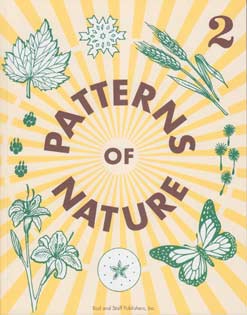
Grade 2 Science WorkbookGrade 2:  Patterns of Nature
Science, at this level, mainly involves identification. Such subjects as seasons, seeds, wildflowers, weeds, trees, mammals, insects, songbirds, and the celestial bodies are introduced on the child's level.

Grade 3: God's Protected World
Units cover water; solids, liquids, gasses; the seasons; heat and cold; care of the body; animals; farming, machines, stewardship. The theme of the book is God's care of man and nature. The Bible theme identifies scientific facts that relate to the story of Noah.

Grade 4:  God's Inspiring World
Students will study weather, animal life, star constellations, light, electricity, plant life. Health and safety are addressed in a unit on human disease and in some lessons such as the lesson on the eye. References from the Book of Job help establish the theme of the book.
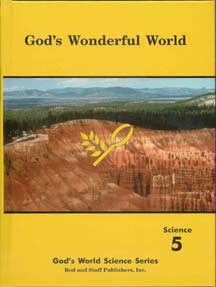
Grade 5 Science "GodGrade 5:  God's Wonderful World
Students will learn the basics of orderly, scientific study. God's wonderful world is best understood by careful observation and by consistent testing of one's conclusions. They will observe God's power and control, study and classify various forms of life, and become acquainted with practical applications of everyday science as well as the value of conserving God-given resources and the value of observing safety. References from the Book of Psalms help establish the theme of the book.


Grade 6:  God's Inhabited World
Students will learn about the solar system, energy, food chains, electricity and magnetism, body systems and health, and the earth with its support of life. The book theme, "God's Inhabited World," strongly emphasizes how God designed the earth for life and designed life for the earth. The spiritual tone is drawn from the Book of Isaiah, and the values of good stewardship are emphasized.

Grade 7:  God's Orderly World
The book theme, "God's Orderly World," frequently shows the orderliness in the laws and designs of God's Creation. Another goal is to help the student understand the error of false science and how to guard against losing Biblical faith.

Grade 8:  God's Orderly World
Students learn the laws of energy and motion as well as integumentary, skeletal, muscular, circulatory, lymphatic, and excretory systems, nutrition and digestion. They also learn about backyard stargazing and deep-space objects, heat energy; weather and weather forecasting; the nervous system, the senses, and the mind; health, safety, and basic first-aid procedures.

Grades 9 & 10:  God's Orderly World
Students will learn the principles of light, including color, optics, and the eye, work and machines, energy and engines, principles and applications of chemistry, electricity, magnetism, generators, motors, circuits, electronics, and electrical safety as well as an introduction to reproduction and heredity.


Closer look at God's Orderly World, Grade 7.

"God's Orderly World frequently shows the orderliness in the laws and designs of God's Creation. Another goal is to help the student understand the error of false science and how to guard against losing Biblical faith."


Unit 1: What Is Science?
An Orderly World
A Discoverable World
The Scientific Method
A Scientific Attitude
Practical Use of Science
A Dependable World
Why Study Science?
Limitations of Science
Unit 1 Review

Unit 2: Life on the Earth
God, the Source of All Life
Characteristics of Life
Cells of Life
The Cell Membrane
The Protoplasm
The Cytoplasm
The Nucleus
Function of Cells
Multitudes of Living Things
Survey of the Monera and Protista Kingdoms
Survey of the Fungi Kingdom
Survey of the Plant Kingdom
Spore-producing Plants
Seed-producing Plants
Survey of the Animal Kingdom
Unit 2 Review
First Quarter Review: Units 1-2

Unit 3: Natural Resources of the Earth
The Earth, Shaped by God
Ecology and the Balance of Life
The Atmosphere
Water
Soil
Mineral and Fuel Resources
Nonrenewable and Renewable Resources
Stewardship of Natural Resources
Biblical Principles of Good Stewardship
Practical Conservation of Natural Resources
Unit 3 Review

Unit 4: Sound
Sound and Faith
Sources of Sound
The Transmission of Sound
The Speed of Sound
Differences in Sound
The Volume of Sound
The Pitch of Sound
The Quality of Sound
The Regularity of Sound
The Larynx, a Versatile Sound Producer
The Ear, a Masterpiece of Creation
Parts of the Ear
Care of the Ears
Using the Ears Wisely 
Unit 4 Review
Second Quarter Review: Units 1-4

Unit 5: Fire
Use and Control of Fire
Fire, a Chemical Reaction
Requirements for Burning
Fuel
Oxygen
Heat
Fighting Fires
Fire Types and Fire Extinguishers
Dealing With Fire Emergencies
Preventing Fires
Common Causes of Accidental Fires
Unit 5 Review

Unit 6: The Force of Gravity
Gravity, a Mysterious Force
The Bible and Gravity
The Orbits of Heavenly Bodies
The Earth's Gravity
Weight
Density
Gravity and Water Pressure
Buoyant Force
Gravity and Atmospheric Pressure
Lifting Liquids With Atmospheric Pressure
Creating a Partial Vacuum
Lighter-than-air Balloons
Unit 6 Review
Third Quarter Review: Units 1-6

Unit 7: Diseases
The Body, a Gift From God
When Sickness Comes
A Doctor's Instruments
Infectious Diseases
Diseases Caused by Germs
Common Disease Parasites
Defenses Against Infectious Diseases
Sanitary Living
Personal Hygiene
Sanitation in Other Areas
Other Kinds of Diseases
Allergies
Degenerative Diseases
Nutrition-related Diseases
Congenital and Heriditary Diseases
Cancer
A Biblical View of Medicine
Unit 7 Review

Unit 8: Agriculture
The Importance of Farming
The Farmer as a Steward
Stewardship of Soil
Care of the Soil
Stewardship of Crops
Stewardship of Livestock
Farming as an Occupation
Unit 8 Review
Final Review: Units 1-8

Thursday, October 13, 2016

ADVENT: Cookie Outreach Invitation

I posted before about an Advent neighborhood outreach postcard. It's intended to drop off at homes around everybody's neighborhood or the neighborhood around the church. This one is different. It's not an invitation to church, it's (I hope) an invitation to Jesus or a seed, a reminder that Jesus, the tiny baby boy whose birth we celebrate every year, was born for a reason. To that end I added another verse to the usual Christmas card verse:
For Christ also suffered once for sins, the righteous for the unrighteous, to bring you to God. He was put to death in the body but made alive in the Spirit.  (1 Peter 3:18)

People often share cookies with their neighbors and friends so why not add a postcard intended to share what you believe in a simple way. I couldn't find a commercial Christmas card that said what I wanted to say so I created one that's a little more direct than the usual trite, overused phrase, "Jesus is the reason for the season." I finally gave up and went where I should have gone in the first place, the Bible. God will speak for us. Here's what I came up with. Feel free to copy them or create one of your own!